Will AI Replace Coaches? My Thoughts as a Coach
Will AI Replace Coaches?
My Thoughts as a Coach
During my recent Self-Audit Challenge, one of the participants asked me a question I suspect many people are quietly wondering:
“With AI becoming so advanced… do people even still need coaches?”
It’s such a valid question.
Artificial intelligence is moving quickly.
I use AI myself in my business. It helps with brainstorming, structuring ideas, creating content, organising information, and saving time. Used well, it’s an incredibly powerful tool.
But when it comes to coaching?
I believe something important gets missed if we assume information and transformation are the same thing.
Most People Don’t Need More Information
Let’s be honest.
Most people already know what they should be doing.
They know they need to:
stop procrastinating
have the difficult conversation
set healthier boundaries
believe in themselves more
stop overthinking
take action on the business idea they keep talking about
prioritise their wellbeing
stop putting everyone else first
And yet… knowing something intellectually doesn’t automatically create change.
If it did, far more people would already be living the lives they say they want.
The gap is rarely information.
The gap is implementation, emotional resistance, fear, self-doubt, avoidance, old patterns, and often simply not being able to clearly see ourselves.
That’s where coaching becomes powerful.
AI Can Give Information. Coaching Creates Awareness.
AI can absolutely provide ideas.
It can generate plans.
It can suggest frameworks.
It can offer prompts.
It can help someone think differently.
But coaching is not simply about providing answers.
Great coaching helps people access their own answers.
And that’s a very different thing.
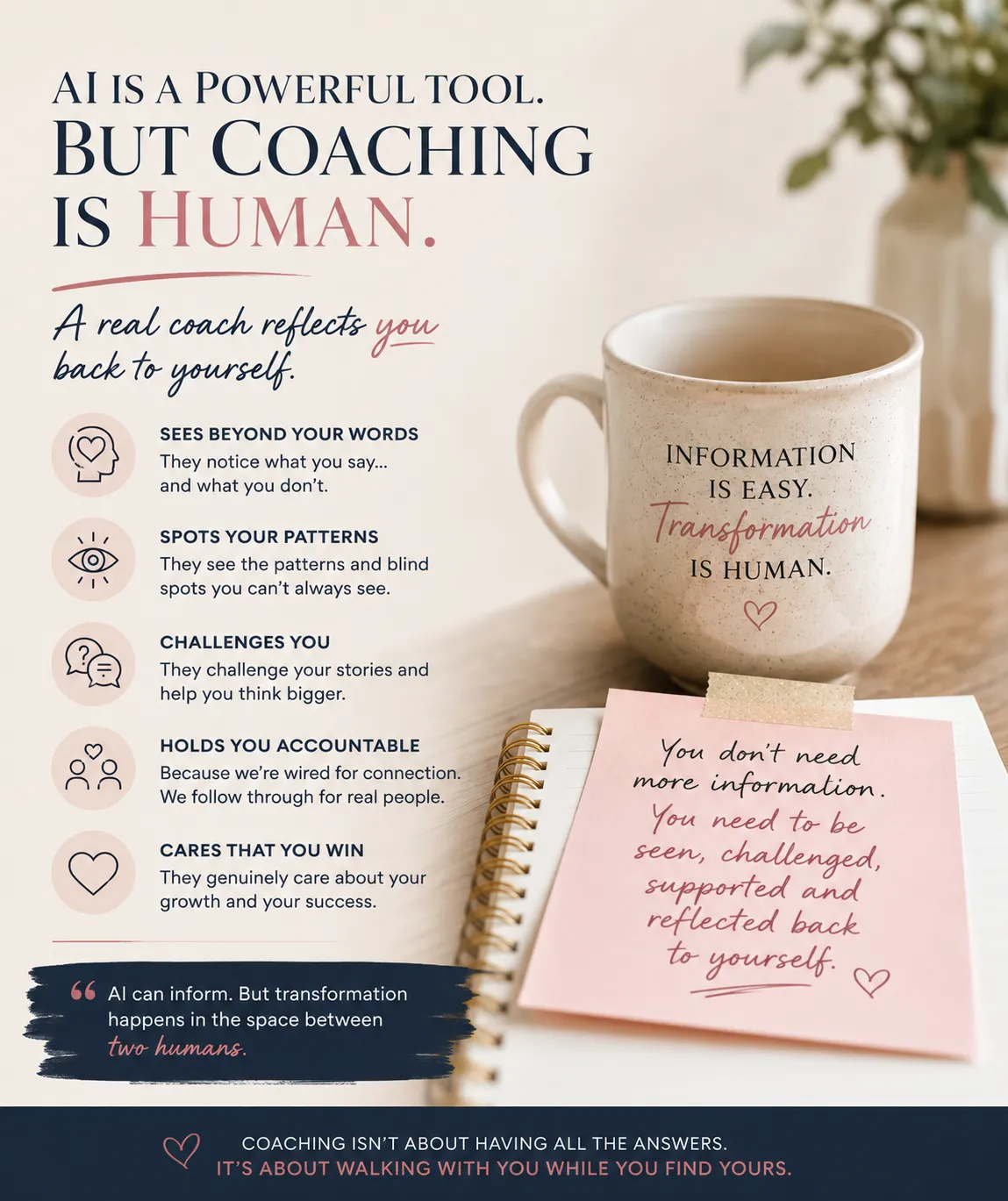
A real coach listens beyond the words.
They notice hesitation.
They hear contradictions.
They spot when someone says they want one thing but their language reveals fear about actually having it.
They notice when a plan sounds polished but clearly doesn’t fit the reality of that person’s life.
That level of reflection matters.
Because sometimes what changes us is not advice.
It’s being truly seen.
Human Reflection Changes People
One of the most transformational parts of coaching is reflection.
A real coach reflects you back to yourself.
Not the version you think you should present.
The real version.
The woman who says she wants to start a business but keeps postponing the first step.
The woman who says she wants a healthier relationship but keeps choosing emotionally unavailable partners.
The woman who says she wants more purpose but dismisses her own gifts because they come naturally to her.
We all have blind spots.
And blind spots are incredibly difficult to spot from inside our own thinking.
That’s why conversation with another human can be so powerful.
Not because they “fix” us.
But because they help us see what we cannot always see alone.
Accountability Works Differently With Humans
AI can send reminders.
Apps can prompt us.
Notifications can ask whether we’ve completed the task.
But most of us have become very good at ignoring digital prompts.
Swipe.
Dismiss.
“I’ll do it later.”
Human accountability works differently.
Because human beings are wired for connection.
We respond differently when someone genuinely remembers what mattered to us last week.
When someone notices we’ve avoided something.
When someone asks the question we were hoping wouldn’t come up.
Not because of guilt.
Because of connection.
Because we matter to another person.
That creates a different kind of commitment.
Will AI Change Coaching? Absolutely.
Do I think AI will change how coaches work?
Absolutely.
It already is.
AI can help coaches save time, improve efficiency, organise notes, create resources, identify patterns more quickly, and spend more time doing what humans do best.
But replacing the deeply human experience of being witnessed, challenged, supported, and reflected back to yourself?
I don’t believe technology replaces that.
Final Thoughts
AI is powerful.
But transformation rarely happens through information alone.
Real change happens when awareness meets honesty, courage, support, and action.
And often, that happens in conversation.
So if you’re wondering whether coaching still matters in the age of AI?
My answer is simple:
Yes. Perhaps now more than ever.
Because in a world full of information, being truly seen has become even more valuable.

